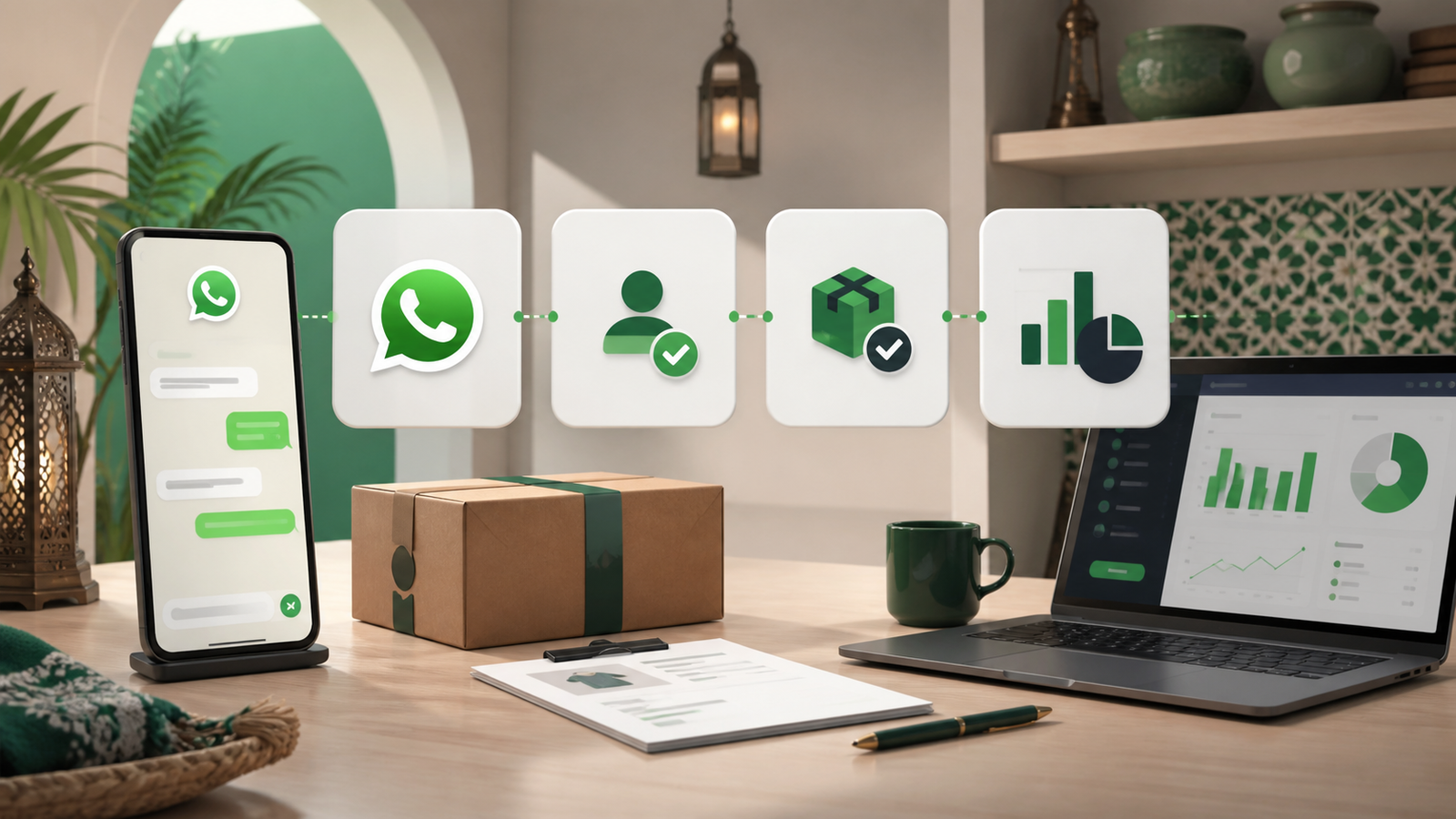
"Automation" scares a lot of merchants, often because the word suggests a cold robot replacing all human contact with the customer. In practice, that's almost never how it goes well. The businesses that succeed at WhatsApp automation keep the human touch for what really matters and let the machine handle the rest — which usually represents most of the volume but very little of the real value of the conversation.
The question therefore isn't "should I automate," but "in what order," because automating everything at once is the best way to get lost and give up after two weeks.
Step 1: answers to repetitive questions
This is almost always the best starting point, because it's where the time savings are the most visible and the quickest. Look at your last hundred incoming messages: a large share asks almost identical questions — availability, price, delivery time, payment method, how to order. These are answers you already give, word for word, several times a day.
Having an assistant answer those questions frees up a considerable amount of time without ever touching customer relationships, since these are exactly the messages where the customer isn't expecting a conversation, just a quick piece of information.
Step 2: simple order taking
Once common questions are handled, the next step is to let the system record an order directly when the customer has clearly made their decision: "I want size M in black, delivery to Agadir." Here, automation isn't replacing a negotiation; it simply captures a decision already made, which avoids losing the order if nobody is available at that moment to write it down by hand.
It's also the step where connecting WhatsApp to your stock and order management starts to pay off, because the order goes straight into the right flow, with no re-entry or copy errors.
Step 3: after-sales follow-up
Once the order is placed, two automatic messages are enough to change a lot of things: an immediate confirmation, and a notification when the parcel actually leaves for delivery. These are two messages most Moroccan merchants never send, for lack of time, even though they clearly reduce the number of customers who refuse delivery for lack of news.
Step 4: campaigns and re-engagements
This is the most advanced step, and the one we recommend keeping for last. Once the first three building blocks are running properly, you can start automatically following up with customers who asked a question without finalizing their order, or warn a list of customers when a highly sought-after product is back in stock. It's powerful, but it requires having a clean conversation history first, which only naturally happens after implementing the previous steps.
What we don't recommend automating
Complaints, price negotiations, and generally anything outside the usual framework should stay in the hands of a person. It's not just a matter of service quality; it's also where loyalty is built. A customer who feels they're talking to a real human when something goes wrong generally stays a customer far longer than one who was sent a poorly-tuned automatic reply.
In practice
Most of the stores we work with take between two and three weeks to get through the four steps, often less. The classic mistake is wanting to jump straight to step 4 because it's the most impressive on paper, when it's steps 1 and 3 that pay off fastest, with the least setup effort.
Want to put this into practice?
GoDeals connects your WhatsApp number, your catalog and your orders in one place, with a free trial to see if it fits how you sell.
3-day trial