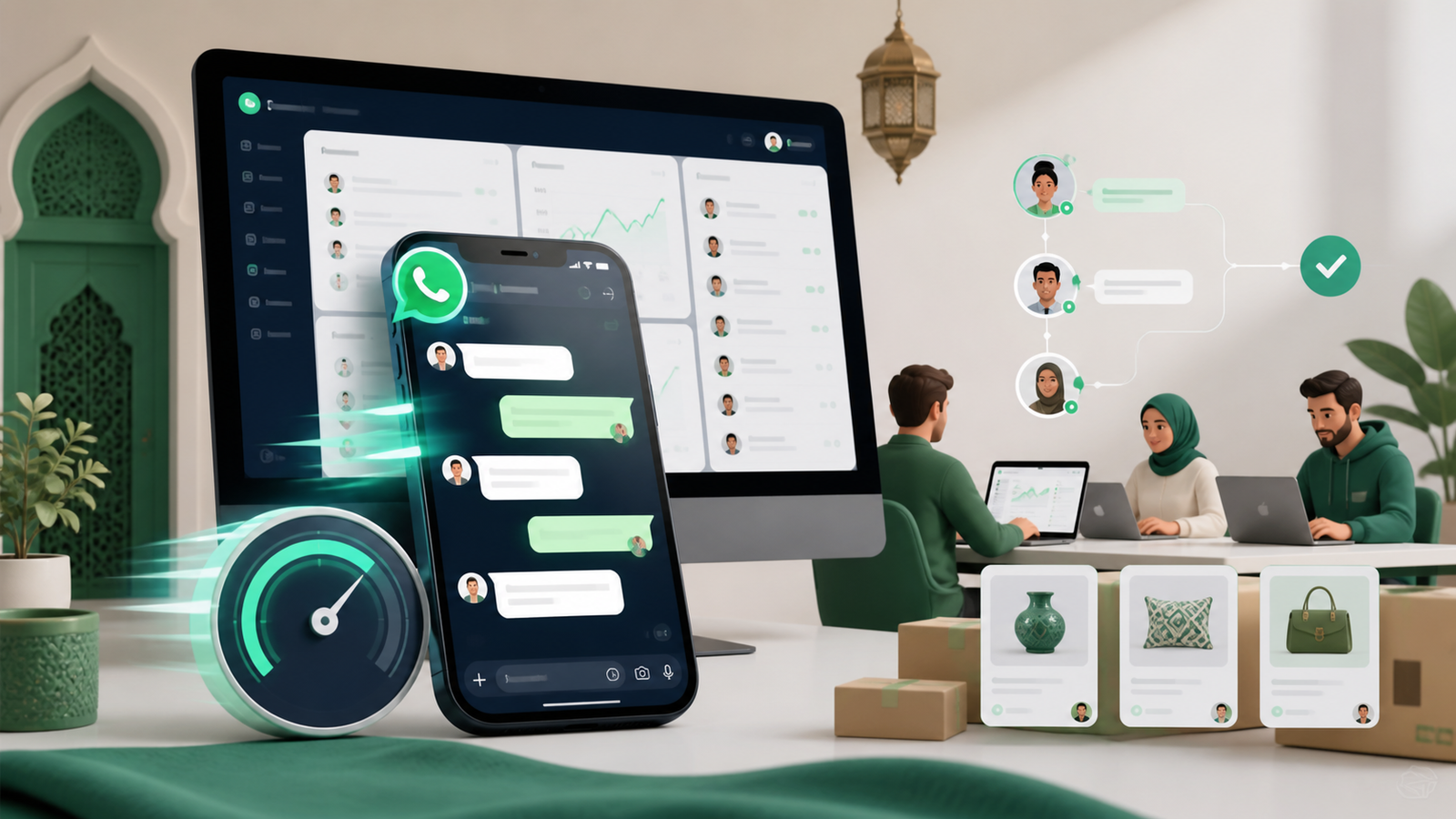
A customer messages you on WhatsApp at 2:03 pm to ask whether an item is still available. If they get an answer at 2:07 pm, they order. If they get it at 4:30 pm, they've already ordered somewhere else — or they've simply forgotten why they wrote to you. This isn't a theory; it's what we observe among almost every merchant selling on WhatsApp in Morocco, from the small clothing seller in Derb Ghallef to the online stores run by three or four people.
The problem is that "replying fast" quickly becomes unsustainable as volume grows. You can't stay glued to your phone all day, and hiring someone just to answer messages is expensive for a small operation. So most merchants skip it and lose sales without really noticing — because a customer who stops replying makes no noise at all.
The real cost of a late reply
We tend to underestimate what a slow reply costs, because you never see it directly on a bank statement. Nobody sends you an invoice for lost orders. But if you look at your WhatsApp conversations over a month, you're almost certain to find dozens of incoming messages where the customer asked a simple question — availability, size, price, delivery time — and never got an answer, or got one three hours later when the desire had already faded.
On an average order of 200 to 300 dirhams, that adds up quickly. Ten missed orders a month is easily 2,500 to 3,000 dirhams going to a competitor who simply replied faster.
What actually works (and what doesn't)
The first thing most merchants do is try to keep up manually. It works for two or three weeks, then the site orders, the deliveries, and the suppliers take over again, and WhatsApp becomes the last priority of the day. That's not a lack of seriousness; it's just that the mental load of running a business leaves no room to watch a phone continuously.
What genuinely changes things is separating two types of messages: those that come back all the time (availability, price, delivery time, how to order) and those that need a real human answer (a complaint, a negotiation, a specific question about a product). The first ones can be handled automatically in seconds, seven days a week, without anyone touching their phone. The second ones stay with you or your team, but you only have a quarter of them left to manage.
That's exactly the kind of triage we built into GoDeals: the assistant answers common questions in darija or French, takes the order if the customer is ready to buy, and hands over to a human as soon as the conversation leaves the usual framework. The customer feels they're talking to someone responsive, not to a robot repeating a script.
A detail very few people check
Many merchants think the problem is message volume. In reality, the main problem is often the hour. The majority of WhatsApp messages arrive between 8 pm and midnight, when people come home from work and finally have time to shop online. If your team finishes at 6 pm, you systematically miss the busiest time of the day. A system that replies even at night — even just to confirm availability and record the order — recovers a large share of the sales that evaporate after closing time.
Where to start
No need to change everything at once. Start by looking, over one week, at how many messages remain unanswered after more than an hour. That single number tells you whether this is worth dealing with now or whether you can still wait. For most stores doing more than a dozen WhatsApp orders a day, the answer is usually yes — and the sooner you get to it, the faster the sales come back.
Want to put this into practice?
GoDeals connects your WhatsApp number, your catalog and your orders in one place, with a free trial to see if it fits how you sell.
3-day trial